
Speed Limits in South Africa: A K53 Learner's Guide
Speed questions look easy, but the numbers are easy to mix up. The speed limits in South Africa come in three layers: a general limit for the kind of road, a class limit for some kinds of vehicle, and a limit shown on a sign. This post puts every number you need in tables, shows how signs change them, and sorts out what the law says about following distance compared with the advice in the learner manual.
The general speed limits in South Africa
The National Road Traffic Regulations (reg 292) set three general limits:
| Where you are driving | General limit |
|---|---|
| Urban area (any public road) | 60 km/h |
| Outside an urban area, on any public road other than a freeway | 100 km/h |
| A freeway | 120 km/h |
These limits apply on every road even when no sign shows them (National Road Traffic Act, s 59). If you are in town and see no speed sign at all, the limit is still 60 km/h. Driving faster than the general limit, a signed limit or a class limit is an offence (s 59(4)).
Two words decide which line of the table you are on:
- In the Act, urban area means land in a municipality that has been surveyed into erven (plots), or that is surrounded by surveyed erven, along with the public roads that border it.
- A freeway is any road, or stretch of road, that has been signposted as a freeway. So the sign makes it a freeway, not the number of lanes.
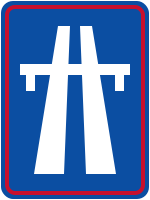
The sign above marks the start of a dual-carriageway freeway. From here the general limit is 120 km/h unless another sign says otherwise.
Class speed limits that matter to a learner
Some vehicles have their own lower limit (reg 293). As a Code 2 learner you will drive a light motor vehicle, so these do not limit your own car. You can still be asked about them, and you share every road with these vehicles.
| Vehicle | Class limit |
|---|---|
| A bus | 100 km/h |
| A minibus or midibus operating under an operating licence (carrying passengers for reward) | 100 km/h |
| A goods vehicle whose gross vehicle mass (GVM) is from just over 3 500 kg to 9 000 kg | 100 km/h |
| A goods vehicle whose GVM is above 9 000 kg | 80 km/h |
| A goods vehicle pulling one or two trailers, where the GVMs add up to more than 9 000 kg | 80 km/h |
| A breakdown vehicle while it tows another vehicle | 80 km/h |
| Any vehicle towed with a rope or chain (reg 330) | 30 km/h |
| A towed vehicle with people in it, unless it is a semi-trailer (reg 330) | 30 km/h |
Three points to watch:
- A class limit applies on every road, freeways included. A bus on a freeway may not do 120 km/h. Its limit stays 100 km/h.
- A class limit never cancels a lower sign. If a truck limited to 80 km/h passes a 60 km/h sign, the driver must keep to 60 km/h. Always obey the lower number.
- The law is wider than the 2012 manual. The manual lists only buses and minibuses in the 100 km/h group. The current regulation also covers midibuses and, since a 2016 amendment, goods vehicles of 3 500 to 9 000 kg. Note also that the law ties the minibus limit to an operating licence, so do not assume every minibus is held to 100 km/h.
The 30 km/h towing limit falls away when a tow-bar or drawbar links the two vehicles instead of a rope or chain. Whatever links them, rope, chain or tow-bar, has a maximum length of 3,5 metres.
How signs change the speed limit
A sign can set a different limit for a stretch of road, higher or lower than the general one. The signed limit then applies on that road. There is one ceiling: no sign may set a limit above the freeway limit of 120 km/h (s 59(2)).
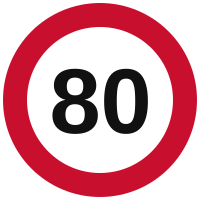
At a speed limit sign like this one, you may not go faster than the number shown. The limit starts at the sign itself, not somewhere after it.
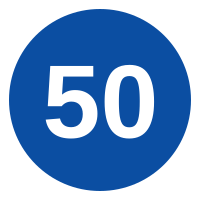
A blue disc with a number is the opposite: a minimum speed. You must keep to at least the speed shown. It is easy to mix these two up, because both are round with a number in the middle. On these two signs, the red ring sets a maximum and the blue disc sets a minimum.
Two more things to know:
- A plate below a warning sign (a curve warning, say) can show a recommended safe speed for that hazard.
- Drivers of ambulances, fire engines and rescue vehicles, and traffic officers, are allowed above the general limit when doing their work, but only with due care for other traffic. While going faster, their siren must sound and their identification lamp must work.
Following distance: what the law says and what the manual advises
This is where many learners give the wrong kind of answer.
The law (reg 308(1)(b)) says the gap behind the vehicle ahead must be reasonable and prudent. It tells you what to weigh up: how fast the vehicle in front is going, how much traffic there is and what state the road is in. The law gives no number of seconds and no distance in metres.
The 2012 learner manual gives practical advice on top of that. It is guidance, not law.
| Question | The law (reg 308) | The 2012 manual's advice |
|---|---|---|
| How close may I follow? | No closer than is reasonable and prudent | At least 2 seconds for a light motor vehicle or motorcycle |
| What about heavy vehicles? | The same test applies | At least 3 seconds |
| What decides the gap? | How fast the car ahead is going, how busy the road is, and its condition | A bigger gap when it rains, when the road is slippery, when you cannot see well, or when a driver behind is too close |
So if a question asks what the manual recommends for a car, the answer is 2 seconds. If a question asks what the law requires, the answer is a distance that is reasonable and prudent. Never pick an answer that says the law demands exactly 2 seconds.
Stopping distance
The gap matters because stopping takes room. The learner manual explains that the distance you need to stop grows when:
- the road is wet;
- you are going faster;
- the vehicle is loaded;
- you are going down a steep hill;
- the surface is gravel, where vehicles skid more easily.
Where you cannot see far ahead, such as on a mountain road with sharp bends, you must be able to come to a stop inside the distance you have a clear view of. Our sources give no stopping distances in metres, so we do not teach a chart of them, and you should be wary of anyone who does.
Practise the numbers until they are automatic
Speed questions sit in the rules of the road section, where you need 22 out of 28 to pass. Learn the three general limits first, then the class limits, then the difference between law and advice on following distance. Module 2 of the study guide covers speed, following distance and overtaking in more depth, and you can test yourself on a free mock test. For the painted lines that go with these rules, read road markings explained.
Ready for your learner's licence test?
Take a full K53 mock test, marked section by section like the real test. Your first one is free.
Start practising free