
K53 Road Markings Explained: Lines, Arrows and Kerbs
Paint on the road can give an order just as firmly as a sign on a pole. Road markings are part of the Department of Transport's learner manual on road signs, so expect them in the signs section of the learner's test, where you need 23 out of 28 to pass. This post explains the road markings a learner must know, each with our own drawing, and when (if ever) you may cross them.
Markings come in three families. Regulatory markings give orders. Warning markings tell you something is coming up. Guidance markings help you place your car on the road. This post covers mostly the first group.
Lines across your lane: stop and yield
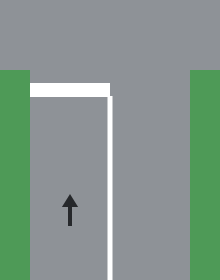
A stop line is a solid white line across your lane. Bring the car to a complete stop with its front behind the line. Here is the part people miss: a stop line has the force of a stop sign even where no sign stands beside it.
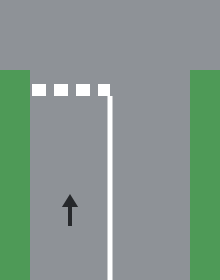
A yield line is a broken line across your lane. It tells you to let anyone go first whose path will cross yours, whether they are already crossing or about to. As with the stop line, this holds even where no yield sign is put up.
At pedestrian crossing lines, people on the crossing, or waiting to step onto it, go first. Slow down or stop for them.
Road markings explained: barrier lines
Solid lines along the road are often called barrier lines. There are two main kinds.
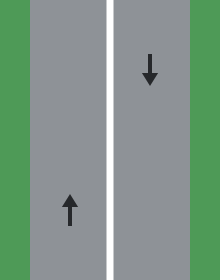
A no overtaking line is a single solid line down the middle of a two-way road. Your whole vehicle must stay to its left, which is why you cannot overtake there.
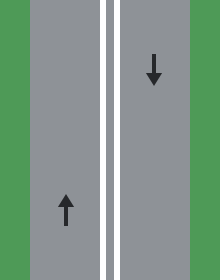
No crossing lines are two solid lines side by side. Keep left of them: crossing them, or driving on their right, is not allowed.
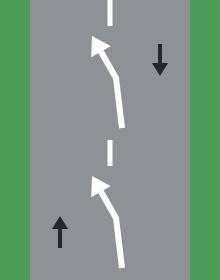
These slanting arrows on a broken centre line are a warning: a no overtaking line or no crossing lines are about to start. Anyone on the right-hand half must return to their own side before the solid line begins.
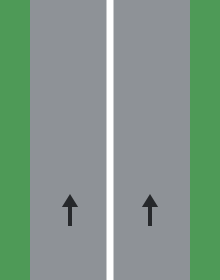
A channelizing line is a solid line separating two lanes that carry traffic in the same direction. Do not let any part of your vehicle cross it.
When you may cross a barrier line
The exceptions are few, and each one applies only when it is safe:
| Marking | You may cross only |
|---|---|
| One solid line (no overtaking) | To reach a driveway or entrance directly across the line, to leave such an entrance and join the road, or to pass something stationary that blocks your way |
| Two solid lines (no crossing) | To get around a stationary vehicle or object in your way |
| Channelizing line | No exception is given |
Notice that "the car in front is slow" is not on the list. Passing a vehicle that is still moving is not one of the exceptions.
The yellow edge line
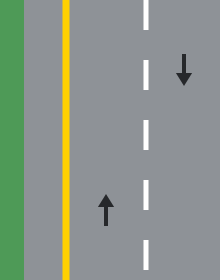
The left-edge line marks where the road ends on the left. In the manual's picture it is yellow. In normal driving, stay to the right of it. The strip beyond it is the shoulder, and the law (reg 298A) allows you onto the shoulder only if every one of these conditions is met: it is daytime, the road has one lane in each direction, you are being overtaken, you endanger no one, and you have a clear view of at least 150 metres.
If your car breaks down, pull over beyond the edge line, as far left as you safely can, and put your hazard lights on.
On freeways, dual carriageways and other one-way roads you will usually also see a right-edge line. Do not cross it.
Painted islands
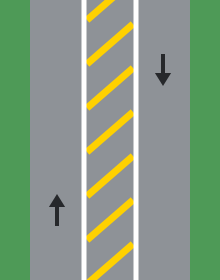
A painted island is a striped area marked out on the road. Do not drive across it, stop on it or park on it. The only exceptions are when a traffic or police officer orders you to, to avoid a crash, or in an emergency.
Lane arrows
There are two kinds of lane arrow. They look alike, but one is an order and the other is a warning.
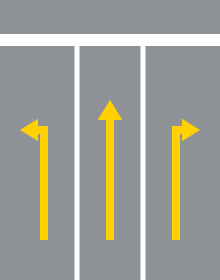
Mandatory direction arrows are painted just before an intersection (yellow in the manual's picture). They are an order: from that lane you may go only the way its arrow points.
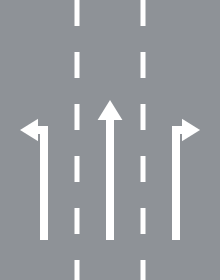
Mandatory direction arrows ahead are painted further back (white in the manual's picture). They are a warning: at the next intersection you will have to follow your lane's arrow, so choose the right lane in good time.
At a traffic circle, curved arrows show the direction to go around it. Drive around it only that way.
Red and yellow lines along the kerb
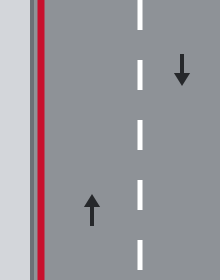
A red line next to the kerb marks a no stopping zone. Stopping there is not allowed, except in an emergency.
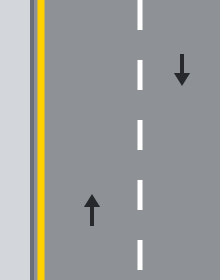
A yellow line next to the kerb marks a no parking zone. A brief stop is allowed, for example to drop off a passenger, but parking is not.
What counts as parking? A car counts as parked when it stays standing, engine on or off, beyond the time needed to load or unload goods or let passengers on or off. The easy way to remember the pair: red is stricter than yellow.
Two more markings worth knowing
- Box junction: a yellow box with crossed lines painted at an intersection. Do not stop inside it, so do not enter the intersection unless you can drive right through.
- Pedestrian crossing ahead lines on the road before a pedestrian crossing: do not stop inside them unless you are giving way to pedestrians or waiting behind a car that has stopped, and do not overtake there.
Learn them with the pictures
Learn each marking together with its picture and the action it asks of you. Module 9 of the study guide covers road markings together with guidance signs and signals, and our mock tests include them in the signs section. If you also want the numbers behind the lines, see speed limits in South Africa.
Ready for your learner's licence test?
Take a full K53 mock test, marked section by section like the real test. Your first one is free.
Start practising free