
How to Prepare for the Learner's Licence Test: A Study Plan
If you want to know how to prepare for the learner's licence test, the honest answer is: learn the material, not old papers. The computerised test gives each person a random set of questions, so a few memorised papers will not carry you. This plan takes you through the three sections in a sensible order, shows you how to use practice tests properly, and points out the traps that cost people marks.
Before you start: know how you are marked
There are three sections in the test, and every one carries a separate pass mark (Government Notice R.93 of 2006):
- Rules of the road: 22 out of 28
- Road traffic signs: 23 out of 28
- Vehicle controls: 6 out of 8
You must pass all three. A high total does not save a weak section. Our post on the learner's licence test pass mark shows worked examples.
Step 1: Take a first mock test
Do one full mock test before you study anything. Do not guess wildly; just answer what you can. The point is not the score. The point is to see which of the three sections is weakest, so you know where your time should go. The first mock on our practice page is free.
Step 2: Learn the sign classes first
Signs make up 28 questions and leave you only five mistakes, so start here. Do not try to learn hundreds of signs one by one. Learn the classes first, because the shape and colour of a sign tell you what kind of message it gives before you even look at the symbol.
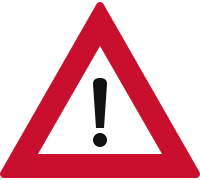
A triangle with a red border is a warning sign. This one, the general warning sign, warns you that some sort of danger lies ahead.
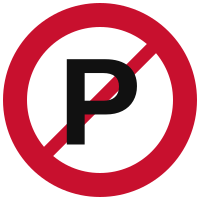
A white circle ringed in red forbids something. This one means no parking there, whatever the hour.

A blue circle with a white symbol tells you what you must do. This keep left sign is placed where something blocks the road, a traffic island for example. Drive past on the side the arrow points to.
And a yellow background means a temporary sign: something on the road is not as it normally is, as at road works. Once you know the classes, learn the members of each class, including the uncommon ones. A Western Cape official told EWN that the computerised test draws on a wider variety of signs than the old fixed test books. Our guide to road signs by shape and colour covers every class.
Step 3: Learn the rules, with their numbers
The rules section is full of numbers, and the wrong options are often real numbers from a different rule. Learn each number together with the rule it belongs to. A few that are easy to mix up:
| Rule | Number |
|---|---|
| General speed limit: urban area / outside an urban area (not a freeway) / freeway | 60 / 100 / 120 km/h |
| Main beam must let you see ahead at least | 100 m |
| Dipped beam must let you see ahead at least | 45 m |
| Daytime: lights on when people and vehicles are not clear at | 150 m |
| Warning triangle, from the stopped vehicle, at least | 45 m |
| Tyre tread on a light motor vehicle, at least | 1 mm |
| Longest tow-rope, chain or tow-bar | 3,5 m |
Make flashcards of these and go through them for a few minutes every day. Do not skip the rules about the vehicle itself, such as lights, tyres and loads. The computerised test appears to draw on these too.
Step 4: Learn the controls
The controls section is only eight questions, which is why people neglect it. But a third mistake fails the whole test. In the official controls manual, the controls of a car are numbered 1 to 11 on a drawing, and its sample questions refer to those numbers. Learn which control goes with each number, and what each is for. One point worth knowing: number 8, the clutch, does not exist in an automatic.
Step 5: Use mock tests and section scores
Once you have worked through the three sections, go back to the mock tests. Use them in a loop:
- Sit a full mock in one go, without notes.
- Read the three section scores against 22, 23 and 6, not the total.
- Review every wrong answer and read the explanation.
- Go back to the study material for the weak section.
- Sit another mock.
You are ready when you clear all three minimums with room to spare in several mocks in a row.
Common traps
The manual's advice is not always the law
The official learner driver manuals date from 2012. In a few places they give advice that is not in the law, or they are out of date. Some examples:
- Following distance. The manual says to keep at least 2 seconds behind another vehicle in a car, and 3 seconds in a heavy vehicle. That is the manual's guidance. The law itself only says you may not follow more closely than is reasonable and prudent.
- Reporting a crash. The manual says to report every crash within 24 hours. The current Act says 24 hours where someone is killed or injured. Where there is only damage, the deadline is the first working day after the crash.
- Babies in a car. According to the manual, the seatbelt law applies only from age 3. Since 2015, the law says a child under 3 must sit in a child restraint.
- Flashing your headlights to overtake. The manual describes this for any road. The law provides for it on a freeway.
Our study material teaches the law on these points. The official test may still mark the manual's answer, so know both versions.
Other easy mistakes
- Mixing up near numbers: 45 m and 100 m, 30 m and 150 m, 60 and 100 km/h.
- Missing the vehicle in the question. A rule for a bus or a goods vehicle may differ from the rule for a car.
- Missing one key word: urban or not, day or night, minimum or maximum, may or must.
Test-day reading tips for three-option questions
Our mocks give three options, with one correct answer. (The number of options on the official test has not been published.)
- Read the whole question first. Is it asking what a sign means, what you must do, or a number?
- For a sign question, look at shape and colour first. That can rule out an option before you read the symbol.
- Read all three options, even if the first looks right.
- Ask where each wrong option comes from. Often it is a real rule for another road, vehicle or light.
- Pick the option that fits the rule precisely, not the one that sounds safest.
- Never learn answer letters. The computerised test is reported to shuffle the options.
Start today
Open the free introduction to the study guide for an overview of the test, and sit your first free mock on the practice page. The full study guide then takes you through signs, rules and controls one module at a time.
Ready for your learner's licence test?
Take a full K53 mock test, marked section by section like the real test. Your first one is free.
Start practising free