
K53 Road Signs: How to Read Any Sign by Shape and Colour
The signs section of the learner's test has 28 questions, and you need 23 of them right. That leaves room for only five mistakes. The good news is that you do not have to learn every K53 road sign from scratch. South African road signs follow a system of shapes and colours, and once you know it, you can tell what kind of message a sign gives before you even read its symbol. This guide walks through each class, with our own drawings as examples.
The quick key
| What you see | What kind of sign | What it does |
|---|---|---|
| Round, blue, white symbol | Regulatory: command | Tells you what you must do |
| Round, white with a red ring, black symbol | Regulatory: prohibition | Tells you what you may not do |
| Upright blue rectangle with R or P | Regulatory: reservation | Sets a road, lane or parking area aside for certain vehicles |
| Eight sides, triangle pointing down, diamond | Regulatory: control | Stop, yield, pedestrian priority |
| Triangle with a red border | Warning | Alerts you to danger on or next to the road |
| Yellow background | Temporary | Normal conditions have changed |
Now let us look at each class.
Regulatory signs: you must obey them
Regulatory signs are usually round. They are not advice: ignoring one is an offence, punishable by a fine, imprisonment or both. There are four groups.
Control signs
Three control signs break the round rule, so you can spot them by shape alone.
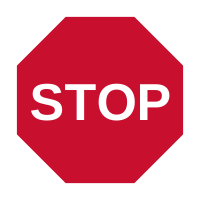
The stop sign has eight sides. You must stop behind the stop line, and move on only when it is safe. If there is no stop line, stop with the front of your car level with the sign.
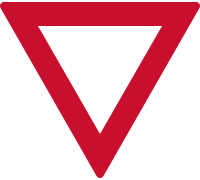
The yield sign is a triangle. Here you let other traffic go first, slowing down and stopping when needed.
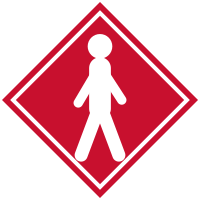
The pedestrian priority sign is diamond-shaped. Pedestrians have priority in the area it marks. Other traffic is limited to emergency and maintenance vehicles and those delivering or collecting goods, at 15 km/h at most.
Other control signs include the no entry sign and the one-way roadway signs.
Command signs
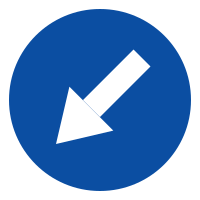
Command signs are round and blue, with a white symbol. They tell you what you must do. The keep left sign above is placed where something blocks the road, a traffic island for example. Drive past on the side the arrow points to. Other command signs tell you to turn in one direction only, or set a road aside for pedestrians or cyclists only.
Prohibition signs
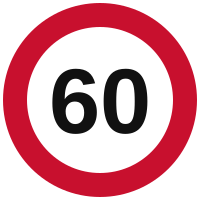
Prohibition signs are white circles inside a red ring, with the symbol in black. They tell you what you may not do. A speed limit sign means you may not go faster than the speed shown, from the sign onwards. This one shows 60 km/h. Other prohibition signs ban parking, overtaking, U-turns or certain vehicles.
Reservation signs
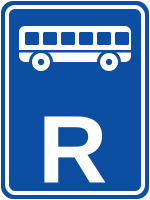
Reservation signs are tall blue rectangles showing a white symbol of a vehicle class. A letter R means a road or lane is reserved; a letter P means a parking area is reserved. The bus reservation sign above reserves the road or part of it for buses only. Other vehicles must keep out.
Signs that cancel a restriction
When a restriction ends, you may see the same sign with a red cross over it. This is a de-restriction sign: past it, the sign under the cross no longer applies to you.
Warning signs: danger ahead
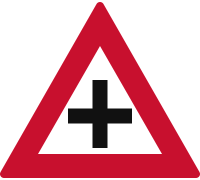
Warning signs alert you in good time to dangerous conditions on or beside the road. Their usual shape is a triangle, point up, with a red edge, a white middle and a black symbol. The crossroad sign above warns of a crossroad ahead: approach with care, look both ways, and be ready to stop for traffic crossing your path.
Temporary signs: yellow means something has changed
A yellow background marks a temporary sign. It tells you that the usual conditions do not apply, for a few minutes or for months, so you must pay closer attention. You will see them at road works, building and maintenance sites, crash scenes, and where traffic is managed for a time, for example at school grounds or by scholar patrols. Temporary signs have a T in front of their number.
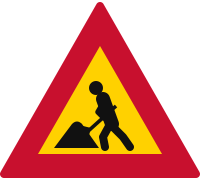
Warning signs have temporary versions with the same symbol on yellow. The road works sign above warns of construction or maintenance work ahead: reduce speed and keep an eye out for further temporary signs and for anyone directing traffic.
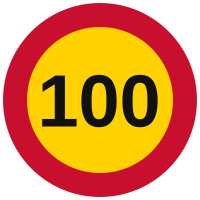
Regulatory signs have temporary versions too. A temporary prohibition sign keeps its red ring but has a yellow background, like this temporary 100 km/h limit. Temporary command signs are yellow with black symbols.
Guidance signs: finding your way
Guidance signs help you find your way. They show route numbers, places and distances. A few of their symbols are worth knowing.

A black T inside a yellow circle marks a toll route. The same symbol crossed out in red marks the end of the toll route, and a black A on a yellow disc marks the alternative route.
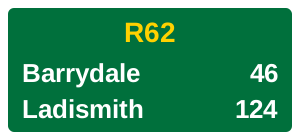
You find a confirmation sign shortly beyond an intersection. It shows the route you are on, the places it leads to, and how many kilometres away they are.
Information signs
Information signs give you useful facts about the road ahead.
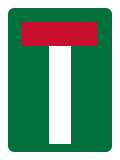
The cul-de-sac sign above shows that the road ahead comes to an end. Do not turn into it unless that is where you are going. Small plates fixed under other signs are information signs too: they add a distance, a safe speed, or what the danger is.
How to use this in the test
When you meet a sign question, read the sign in two steps:
- Shape and colour first. Is it ordering you, forbidding you, warning you, or guiding you? Is it yellow, and so temporary?
- Then the symbol. Now work out the exact meaning.
Step one often rules out an option straight away. A triangle with a red border cannot mean "parking reserved for buses".
Then learn the less common signs in each class as well. The computerised test is reported to draw on a wide range of signs, so the familiar stop, yield and speed signs are not enough.
Keep going
Practise signs in a full test on the practice page, where the first mock is free. The study guide has a module on regulatory signs, one on warning signs and road works, and one on guidance signs, markings and signals. For how the signs section is scored, see our post on the learner's licence test pass mark.
Ready for your learner's licence test?
Take a full K53 mock test, marked section by section like the real test. Your first one is free.
Start practising free