
K53 Vehicle Controls Questions: How to Get 6 of 8
The vehicle controls section is the shortest part of the learner's licence test, and it leaves you the least room for error. It has only 8 questions, and you need at least 6 of them right. Get three wrong and you fail the whole test, however well you did on rules and signs. The good news is that K53 vehicle controls questions draw on a short list of facts, so this is a section you can master.
How the vehicle controls section is marked
The pass marks were set in Government Notice R.93 of 2006, which the consolidated law still carries with no amendment:
| Section | Questions | You need |
|---|---|---|
| Rules of the road | 28 | 22 |
| Road traffic signs | 28 | 23 |
| Vehicle controls | 8 | 6 |
Each section is marked on its own and there is no overall pass mark. That makes the controls section risky: with only 8 questions, each one is worth a lot. Under the regulations, the examiner has to be satisfied that you understand the controls of the class of vehicle you are applying for. For a Code 2 learner, that is a light motor vehicle.
What K53 vehicle controls questions look like
Nothing official describes the screens of the computerised test. What we do have is the Department of Transport's 2012 learner manual on vehicle controls, which is the official study guide. Its sample questions show two styles:
- A drawing with numbers. Each control in a car is marked with a number. A question asks something like "Which number do you use to slow the car down?" and you answer with the number, or it gives a number and asks what that control is.
- Select the correct combination. The question gives two or three statements and asks which of them are true together, or which group of controls you use for one action.
So you need two things: the number of each control, and what each one is for.
The controls and their numbers
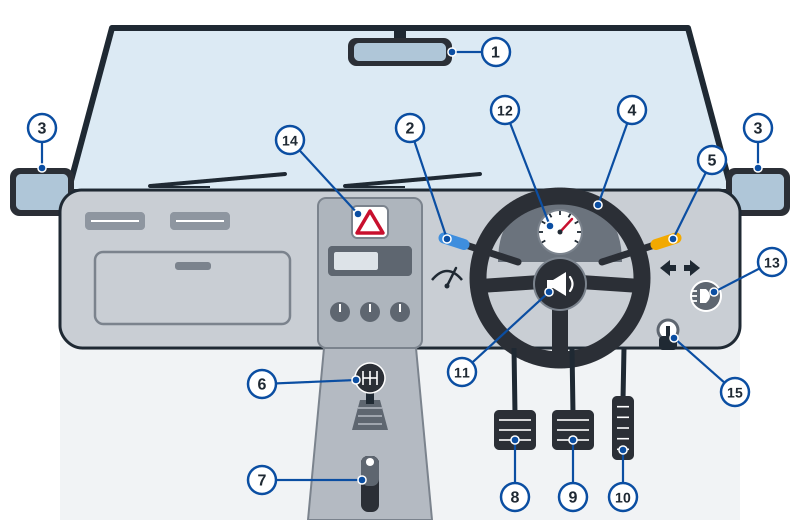
Numbers 1 to 11 in our drawing follow the numbering in the learner manual. Learn these:
| No. | Name | What it is for |
|---|---|---|
| 1 | Inside (centre) rear-view mirror | Lets you see what is behind the car |
| 2 | Windscreen wiper | Cleans the front windscreen; used when driving in rain |
| 3 | Outside mirrors (left and right) | Together with mirror 1, show you what is behind and beside you; the right mirror covers the area behind you on the right |
| 4 | Steering wheel | Turns the car and changes its direction |
| 5 | Indicator switch (lever) | Shows others that you plan to turn, or to move over to the left or right |
| 6 | Gear lever | Chooses the gear |
| 7 | Hand brake (parking brake) | Keeps a parked car from moving |
| 8 | Clutch | Helps you engage or disengage a gear; stops the engine stalling just before the car comes to a standstill |
| 9 | Brake | Slows the car down, stops it, and is used to stop in an emergency |
| 10 | Accelerator | Increases the car's speed |
| 11 | Hooter (horn), in the centre of the steering wheel | Alerts other road users to help avoid a crash |
Our drawing adds a few extras. Number 12 is the speedometer, which the manual labels on its photo of the dashboard, behind the wheel, but gives no number. Numbers 13 to 15 (light switch, hazard switch and ignition) are included so the drawing looks like a real car. The manual gives them no number, so do not learn them as test facts.
Hand and foot controls
- Three controls are worked with your feet: the accelerator (10), brake (9) and clutch (8).
- From left to right, the three pedals are clutch, brake, accelerator.
- The steering wheel, gear lever and indicator switch are hand controls.
- In some cars the parking brake is worked by foot, not by hand. It is still number 7.
Automatic cars
An automatic light motor vehicle has no clutch, so there is no number 8. It has two pedals: the brake (9) on the left and the accelerator (10) on the right. Every other control keeps the same number as in a manual car. The gear lever (6) is still there, but it is used in a different way from the lever in a manual car.
Which controls you use for common actions
The manual links each everyday action to its controls. These are the ones to know:
| Action | Control(s) |
|---|---|
| Speed up | Accelerator (10) |
| Slow down or stop | Brake (9) |
| Change gear in a manual car | Gear lever (6) and clutch (8) |
| Keep the engine from stalling just before standstill | Clutch (8) |
| Steer or turn | Steering wheel (4) |
| Show that you will turn left or right | Indicator switch (5) |
| See what is behind you | Inside mirror (1) |
| See behind and to the sides | Mirrors 1 and 3 |
| Keep a parked car still, or leave it unattended | Hand brake (7) |
| Clear the windscreen in rain | Wiper (2) |
| Warn someone to avoid a collision | Hooter (11) |
| Take a sharp bend in the road | Six controls: 1, 4, 6, 8, 9 and 10 (the accelerator, brake, clutch, gear lever, inside mirror and steering wheel) |
Two habits from the manual matter here. First, check your mirrors first, so you know what is behind you. Second, the manual says you use the inside mirror (1) before you change speed or brake. If a combination question lists the brake and leaves out the mirror, look again.
What the law adds
A few rules of the road are about using these controls, and the law is the final word on them:
- Indicators: signal whenever you turn to the left or right and whenever you change lanes on a public road, then cancel the signal once it has done its job (reg 326).
- Hooter: use it only when it is needed for safety (reg 310A).
- Leaving the car: do not leave a car unattended on a public road without setting the brake or otherwise stopping it from moving, and do not leave the engine running while it stands unattended (reg 308).
- Main beam: dip your bright lights for oncoming traffic (reg 157).
Make these 6 marks your safest
A slip in this small section fails the test just as surely as a weak score in signs or rules. Learn the eleven numbers until you can point to each one without thinking, then practise mixed questions. Module 10 of the study guide covers the controls of both manual and automatic cars, and every mock test has its own controls section marked out of 8. To see where else learners drop marks, read why learners fail the K53 test.
Ready for your learner's licence test?
Take a full K53 mock test, marked section by section like the real test. Your first one is free.
Start practising free